
Semaglutide vs Liraglutide: Two GLP-1 Analogues Compared
For laboratory research only. Not for human or animal use. This article gives no dosing, administration or therapeutic advice.
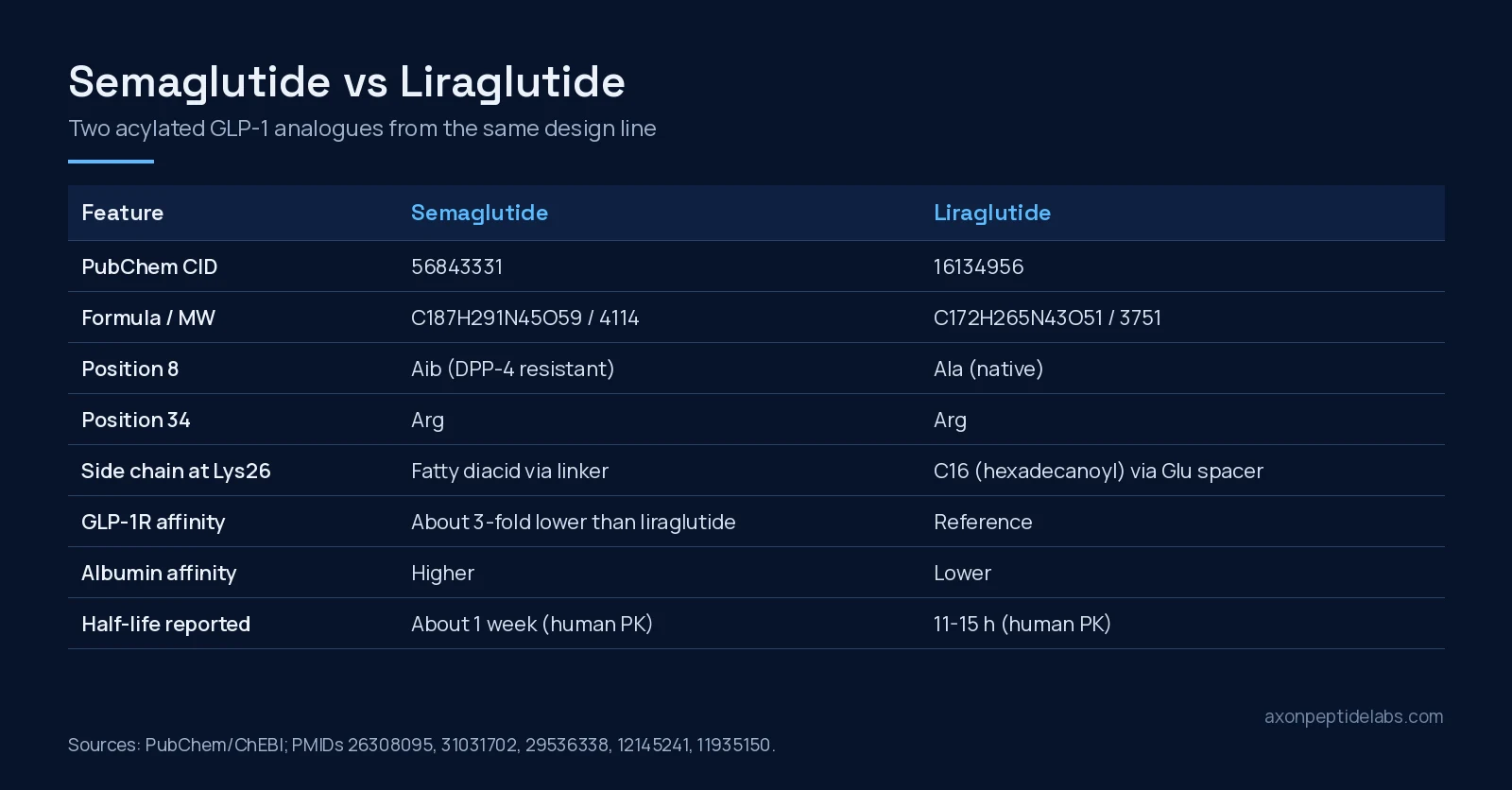
Short answer: semaglutide and liraglutide are both acylated analogues of human glucagon-like peptide-1 (GLP-1), designed by the same research line to last far longer than the native hormone by binding reversibly to serum albumin[1]. Liraglutide keeps the native alanine at position 8 and carries a 16-carbon fatty acid on a lysine through a glutamic acid spacer. Semaglutide swaps position 8 for the non-natural amino acid Aib, uses a longer fatty-acid-and-linker side chain at lysine 26, and was optimised for higher albumin affinity at the cost of about three-fold lower GLP-1 receptor affinity than liraglutide[2]. In human pharmacokinetic studies, liraglutide’s half-life was 11 to 15 hours, while semaglutide’s was about one week[3][4].
The problem both molecules were built to solve
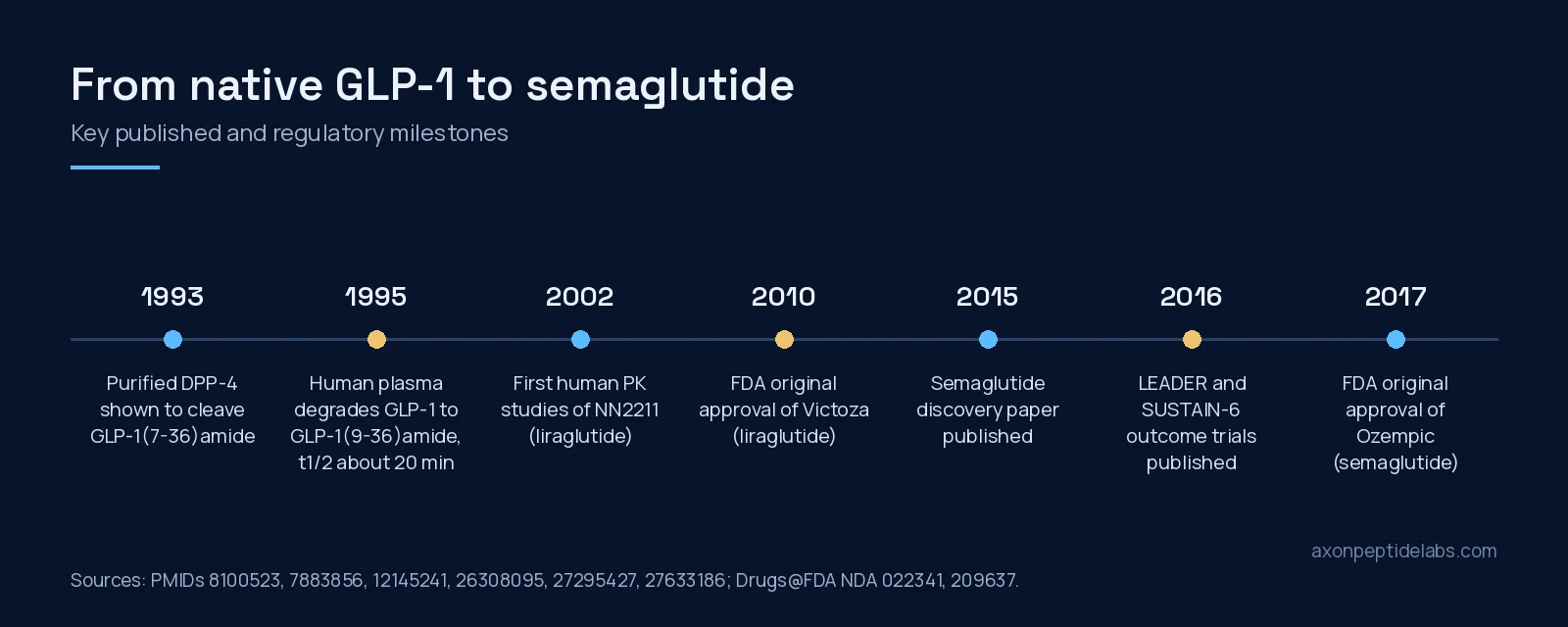
Native GLP-1 does not last. In 1993, dipeptidyl peptidase IV (DPP-4) purified from human placenta was shown to remove the N-terminal His-Ala dipeptide from GLP-1(7-36)amide[5]. Two years later, human plasma was found to degrade GLP-1(7-36)amide to the N-terminally truncated GLP-1(9-36)amide with a half-life of about 20 minutes at 37 °C in vitro. DPP-4 inhibitors or cold temperature fully blocked that step, and the truncated peptide was a major circulating metabolite in vivo[6].
So any long-acting analogue has two jobs: resist that N-terminal cut and avoid rapid clearance. The 2019 account of how both drugs were developed describes the shared answer: reversible albumin binding through a fatty acid and linker, tuned to keep GLP-1 receptor potency while maximising albumin binding[1].
Structure and identity
The identity values below are from PubChem; the structural descriptions are PubChem’s ChEBI summary for liraglutide and the semaglutide discovery paper. These are not certificate-of-analysis values.
| Field | Semaglutide | Liraglutide |
|---|---|---|
| PubChem CID | 56843331 | 16134956 |
| CAS | 910463-68-2 | 204656-20-2 |
| Development codes (PubChem synonyms) | NN9535 | NN2211 |
| Molecular formula | C187H291N45O59 | C172H265N43O51 |
| Molecular weight | 4114 g/mol | 3751 g/mol |
| Backbone | GLP-1 analogue, 31 amino acids | GLP-1 analogue (lipopeptide) |
| Substitutions vs human GLP-1 | Aib8, Arg34[2] | Arg34 (Lys to Arg; position 27 of the chain in ChEBI’s numbering) |
| Lipid side chain | Fatty acid moiety and linker on Lys26[2] | Hexadecanoyl (C16) on the remaining lysine via a glutamic acid spacer |
The two molecules share the Arg34 change, which leaves a single lysine for the side chain. The differences are at position 8 and in the side chain. Aib (alpha-aminoisobutyric acid) at position 8 sits inside the His-Ala dipeptide that DPP-4 removes[5], and the discovery team describes the aim as full stability against metabolic degradation[2]. Liraglutide keeps the native Ala8 and relies on its fatty acid for protraction[1].
Receptor and albumin pharmacology
The semaglutide discovery paper is the main head-to-head source on molecular pharmacology. The authors varied the fatty acid and the linking chemistry and found these were the key features for high albumin affinity and GLP-1 receptor potency. Semaglutide’s GLP-1 receptor affinity (0.38 ± 0.06 nM) was three-fold lower than liraglutide’s, while its albumin affinity was higher[2]. In mini-pigs, its plasma half-life after intravenous administration was 46.1 hours[2].
That trade-off is the central design point: a molecule that binds the receptor somewhat less tightly but stays in circulation much longer. Both act through the same receptor, which the 2019 review lists as expressed in the pancreas, gastrointestinal tract, heart, lungs, kidneys and brain[1].
Liraglutide also self-associates in solution. A 2026 comparability study of a chemically synthesised liraglutide against its recombinant reference product found matching secondary structure and NMR fingerprints, a dominant low-oligomeric assembly with apparent aggregation numbers near the hexamer-to-heptamer range, and comparable GLP-1 receptor activity in vitro[7]. That study is also a reminder that sequence identity alone does not settle higher-order structure for lipidated peptides.
What the pharmacokinetic studies measured
Liraglutide entered human studies under the code NN2211. In a single-dose escalation study in healthy men, its half-life was 11 to 15 hours, with time to peak concentration around 9 hours[3]. A multiple-dose study in healthy men reported a half-life of 12.6 ± 1.1 hours and dose-proportional increases in exposure[8].
For semaglutide, a 13-week randomized trial in healthy Japanese and Caucasian men had steady-state exposure as its primary endpoint and found exposure similar in both groups, with accumulation in line with a half-life of about one week[4]. A radiolabel study in humans, rats and monkeys found intact semaglutide was the main circulating component in all three species, 69 to 83% of semaglutide-related material, and that it was metabolised before excretion in urine and faeces[9].
The outcome trials, by design
Both drugs went through large cardiovascular outcome trials. We list their design and primary endpoints only; this article reports no efficacy results.
| Trial | Compound vs comparator | Population and size | Primary endpoint and design |
|---|---|---|---|
| LEADER (Marso et al. 2016)[10] | Liraglutide vs placebo, added to standard care | 9,340 people with type 2 diabetes and high cardiovascular risk; median follow-up 3.8 years | First cardiovascular death, nonfatal myocardial infarction or nonfatal stroke; double-blind, noninferiority margin 1.30 |
| SUSTAIN-6 (Marso et al. 2016)[11] | Semaglutide vs placebo, on standard care | 3,297 people with type 2 diabetes; 104 weeks | Same composite outcome; noninferiority margin 1.8 |
| Ikushima et al. 2018[4] | Semaglutide vs placebo | 44 healthy men; 13 weeks | Steady-state exposure (pharmacokinetics) |
| Agersø et al. 2002[8] | NN2211 (liraglutide) vs placebo | Healthy men | Pharmacokinetics, pharmacodynamics and tolerability |
The two outcome trials enrolled different populations, sizes and durations, so their results cannot be compared directly as if they were one trial.
Regulatory status
Stated neutrally from Drugs@FDA: Victoza (liraglutide) has an original FDA approval dated January 25, 2010 under NDA 022341, and Ozempic (semaglutide) has an original FDA approval dated December 5, 2017 under NDA 209637. Those approvals cover specific finished drug products. A research-grade peptide sold for laboratory use is not one of those products and carries no approval.
What the evidence does not show
- No interchangeability. Different side chains, receptor affinities and albumin affinities[2] mean data for one molecule do not transfer to the other.
- Animal half-lives are not human half-lives. The 46.1-hour figure is from mini-pigs[2]; the human values come from separate PK studies[3][4].
- Albumin binding is not the whole story. Liraglutide’s self-association behaviour also shapes how it behaves in solution[7].
- No efficacy claims here. Outcome trials are listed by design only, and their populations differ[10][11].
- Research material is not the approved product. FDA approvals apply to the specific finished products named above.
Sourcing semaglutide for research
Axon carries Semaglutide 10mg for laboratory research. No certificate is posted for this product on our COA page at the time of writing. We do not sell liraglutide. Related GLP-1 receptor research products sit in our metabolic peptides category. For other comparisons, see semaglutide vs cagrilintide and semaglutide vs tirzepatide vs retatrutide. To compare our wider catalogue, you can buy lab-tested peptides in Canada with batch documentation where it is posted.
Frequently asked questions
What is the main structural difference between semaglutide and liraglutide?
Both are GLP-1 analogues with Arg34 and a lipid side chain on a lysine. Semaglutide also has Aib at position 8 and a different fatty acid and linker at Lys26. Liraglutide keeps native Ala8 and carries a C16 hexadecanoyl chain through a glutamic acid spacer.
Why does semaglutide last longer than liraglutide?
In the discovery work, semaglutide’s side chain and linker were chosen for higher albumin affinity, and Aib8 was part of securing stability against metabolic degradation. Human PK studies reported a half-life of about one week for semaglutide and 11 to 15 hours for liraglutide.
Which binds the GLP-1 receptor more strongly?
In the semaglutide discovery paper, semaglutide’s GLP-1 receptor affinity (0.38 nM) was about three-fold lower than liraglutide’s, while its albumin affinity was higher.
Have semaglutide and liraglutide received FDA approval?
Drugs@FDA lists an original approval for Victoza (liraglutide) on January 25, 2010 and for Ozempic (semaglutide) on December 5, 2017. Those approvals cover those finished products, not research-grade peptides.
Does Axon Peptide Labs sell liraglutide or post a COA for semaglutide?
Axon does not sell liraglutide. No certificate is posted for Semaglutide 10mg on our COA page at the time of writing.
References
- Knudsen LB, Lau J (2019). The Discovery and Development of Liraglutide and Semaglutide. Front Endocrinol (Lausanne). PMID: 31031702. doi: 10.3389/fendo.2019.00155.
- Lau J, Bloch P, Schäffer L et al. (2015). Discovery of the Once-Weekly Glucagon-Like Peptide-1 (GLP-1) Analogue Semaglutide. J Med Chem. PMID: 26308095. doi: 10.1021/acs.jmedchem.5b00726.
- Elbrønd B, Jakobsen G, Larsen S et al. (2002). Pharmacokinetics, pharmacodynamics, safety, and tolerability of a single-dose of NN2211, a long-acting glucagon-like peptide 1 derivative, in healthy male subjects. Diabetes Care. PMID: 12145241. doi: 10.2337/diacare.25.8.1398.
- Ikushima I, Jensen L, Flint A et al. (2018). A Randomized Trial Investigating the Pharmacokinetics, Pharmacodynamics, and Safety of Subcutaneous Semaglutide Once-Weekly in Healthy Male Japanese and Caucasian Subjects. Adv Ther. PMID: 29536338. doi: 10.1007/s12325-018-0677-1.
- Mentlein R, Gallwitz B, Schmidt WE (1993). Dipeptidyl-peptidase IV hydrolyses gastric inhibitory polypeptide, glucagon-like peptide-1(7-36)amide, peptide histidine methionine and is responsible for their degradation in human serum. Eur J Biochem. PMID: 8100523. doi: 10.1111/j.1432-1033.1993.tb17986.x.
- Deacon CF, Johnsen AH, Holst JJ (1995). Degradation of glucagon-like peptide-1 by human plasma in vitro yields an N-terminally truncated peptide that is a major endogenous metabolite in vivo. J Clin Endocrinol Metab. PMID: 7883856. doi: 10.1210/jcem.80.3.7883856.
- Tang Y, Bai M, Lu X et al. (2026). An Orthogonal Framework for Higher-Order Structural and In Vitro Functional Comparability of Chemically Synthesized Liraglutide Relative to an rDNA-Origin Reference Product. Pharm Res. PMID: 42687068. doi: 10.1007/s11095-026-04178-1.
- Agersø H, Jensen LB, Elbrønd B et al. (2002). The pharmacokinetics, pharmacodynamics, safety and tolerability of NN2211, a new long-acting GLP-1 derivative, in healthy men. Diabetologia. PMID: 11935150. doi: 10.1007/s00125-001-0719-z.
- Jensen L, Helleberg H, Roffel A et al. (2017). Absorption, metabolism and excretion of the GLP-1 analogue semaglutide in humans and nonclinical species. Eur J Pharm Sci. PMID: 28323117. doi: 10.1016/j.ejps.2017.03.020.
- Marso SP, Daniels GH, Brown-Frandsen K et al. (2016). Liraglutide and Cardiovascular Outcomes in Type 2 Diabetes. N Engl J Med. PMID: 27295427. doi: 10.1056/NEJMoa1603827.
- Marso SP, Bain SC, Consoli A et al. (2016). Semaglutide and Cardiovascular Outcomes in Patients with Type 2 Diabetes. N Engl J Med. PMID: 27633186. doi: 10.1056/NEJMoa1607141.